THE TWO LITRE MINI
THE TWO LITRE MINI
Firstly, I hope you won’t mind me invading your club space with this story that I am researching and relate here. Back in the dim and distant past I was very much a Mini person, rallying a Cooper S with a stage 2 engine from Alexander tuning. Night rallying on the army land around Farnborough was very much the thing then. But life moves on, and my interests changed, until, now being deep into Jaguar history, I find I have come full circle and that Minis enter into my research.
For you in your club life commenced in 1959, but Jaguar commenced in 1922 as a sidecar maker, graduating to making cars which used Standard-based engines. It was only during the war, while on fire watch duty on the roof of the factory in Coventry, that plans were sketched for a new range of engines to propel Jaguar into the future, the first being tested in 1943. XF, XG, and eventually the eponymous DOHC XK engine was born. What few people know is that it was to be produced in four as well as six-cylinder form.
A few months ago I was offered a four cylinder 2 litre Jaguar engine, which I purchased and which I am now researching. Here is a photo of the engine I now possess, very much a prototype, with water outlets along side each cylinder in the head, two in the block and the water pump, making seven in all to check for hot spots. It was never put into production by Jaguar in the end, and was consigned to history, but a history which is not too well known, and which is now leading me to burn the midnight oil. What is known is that in 1948 Jaguar lent one of these engines to a Major Gardner who used it in a streamline MG and who set a new class world speed record of 173 mph, the engine producing over 140 bhp. A lot for the time, as you can imagine, especially on low octane fuel. That engine is now in the Jaguar museum, and only three were known to exist until mine turned up in Paris a short while ago.
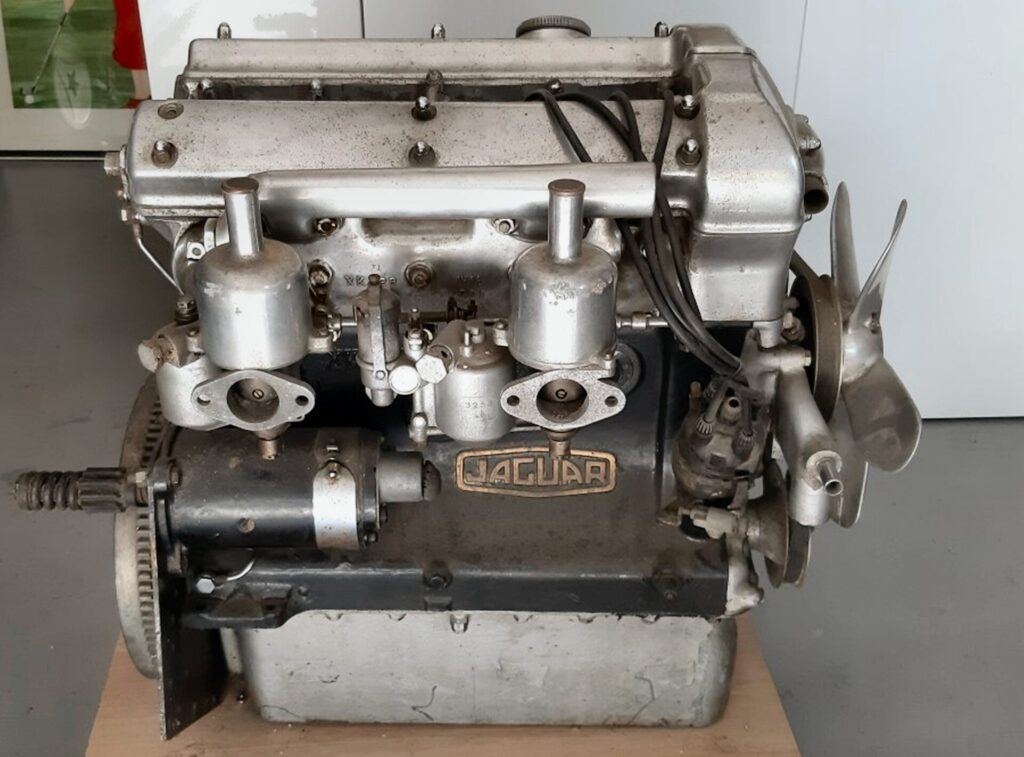
But the engine was dropped, potentially revived in 1953 with a view to using it in the Mk 1 saloon, and a few hundred blocks were cast, but it was too noisy and suffered from vibration problems. Definitively and finally consigned to the archives.
-2-
But it wasn’t it turns out, and this is where you club members may be able to help me please. Rumours started flying that the engine was used for Mini racing, an idea which seemed fanciful to me – until I was sent this photo which has led me to you and your club and where our paths cross. This is most decidedly a Jaguar XK four cylinder engine propelling a Mini and fed by two 40DCOE double choke Webers. Then rumours reached me that racers were taking a six-cylinder engine and doing a cut and shut job, cutting out cylinders 3 & 4 to recreate a four cylinder version, no four cylinder engines remaining. Front-heavy and interesting handling crossed my mind as an ex-Mini rallycross man, but how on earth did it drive the wheels, I ask myself? Was it married to a form of Mini transmission and how could that transmission take the power and torque that this engine would have produced? As with all research, one is set fair and full on a straight road, think you have got to the end – and then there is this thread which has sidetracked me.
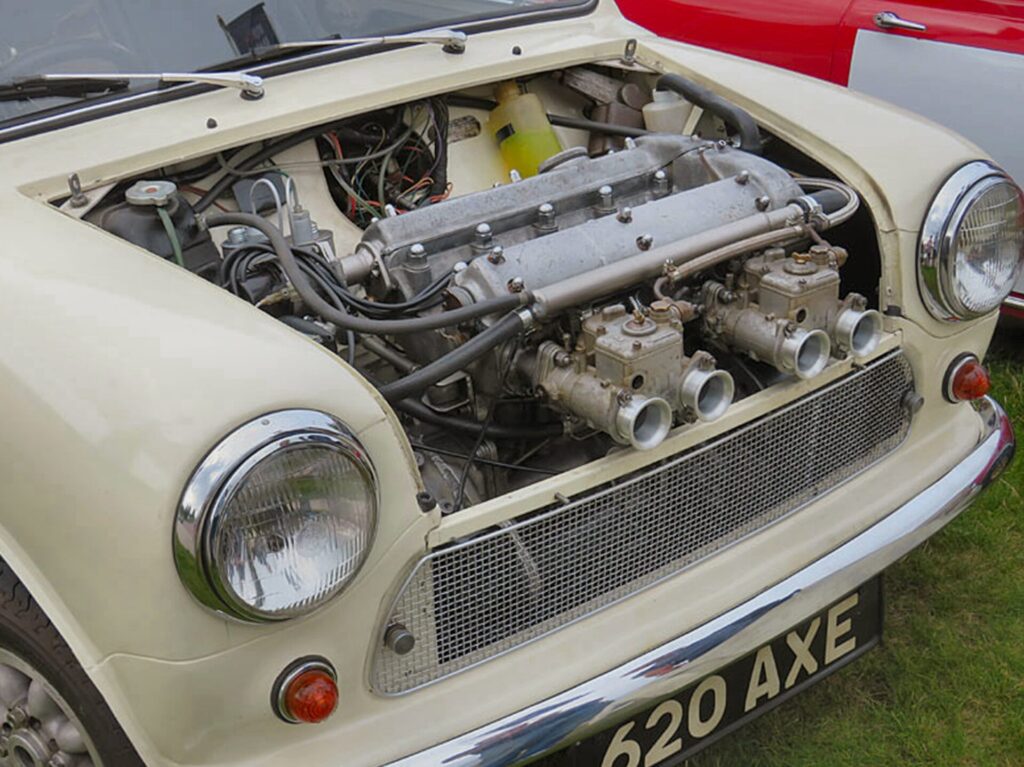
I’ve checked the DVLA and this car still exists but now with a 1498cc engine by the way. I do hope that someone in your club can provide me with more on the fascinating history of this Mini and where the idea came from in the first place, and even put me in touch with someone who raced one. I look forward very much to hearing from you via David Hollis
Yours
Tony Brown
Le Mans